Guides
Opening a recovery studio in Canggu: equipment, throughput, budget
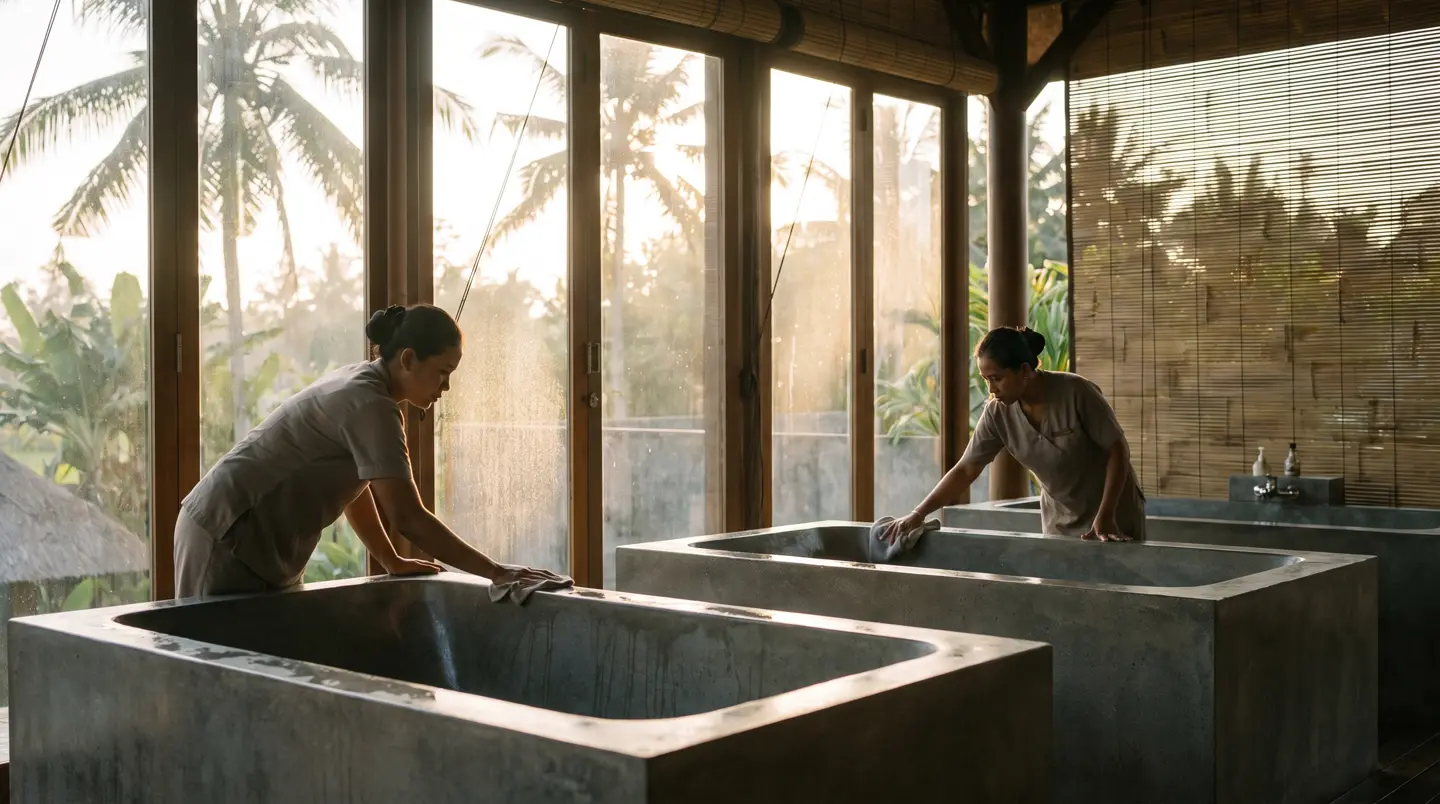
A recovery studio in Canggu that runs contrast sessions for walk-in guests needs a sauna for 8–12 people, two or three chilled plunges, showers, three-phase power and a hygiene routine that survives a 16-hour day. Indicatively, the sauna and plunge equipment alone runs IDR 285–560 million (approx. USD 17,300–33,900) before fit-out, and the build takes 4–8 weeks.
What is driving the studio boom in Canggu?
Walk down Jalan Batu Bolong, Jalan Pantai Berawa or the Pererenan main road and count the recovery, contrast-therapy and bathhouse signs that were not there three years ago; Uluwatu and Ubud are following. The customers are the surf and fitness crowd, remote workers who want a post-work ritual, and retreat groups who buy a block of sessions, and drop-in sessions around the island are commonly priced in the IDR 100,000–500,000 range. The business model is throughput: how many people can move through hot and cold in a 45-minute slot with a clean tub and a hot sauna waiting. Everything in the equipment list follows from that.
What equipment does a contrast-therapy studio need?
| Item | Spec | Indicative price (IDR) |
|---|---|---|
| Commercial sauna, 8 people | 3×2.4 m, 9 kW, 11,000 VA, thermowood, two-tier benches | 150–200 million |
| or 10–12 people | 3.5×2.6 m 10.5 kW or 4×3 m 12 kW, 3-phase | 190–290 million |
| Cold plunges × 3 | Larch tubs with liner, 1 HP chiller each, filter + ozone | 45–90 million each |
| Steam room (optional) | 2×2 m turnkey, 6–9 kW generator | 50–100 million |
| Showers, changing, drainage | Wet-area floor with falls, 2–4 showers | fit-out contractor |
| Electrical | 3-phase board, SiHF circuits, ELCBs, timers | in installation |
| Accessories | Guards, buckets, thermometers, lighting | 1.5–8 million |
The ice bath side is where studios most often under-buy. A sauna for eight seats eight comfortably and ten in a pinch; for a studio planning 60 or more guests a day the ten- or twelve-person cabin pays for itself in fewer bottlenecks. Two plunges is the minimum, three is comfortable, because one tub is always warming up or being changed.
How many guests can the studio handle in a day?
Work it backwards from the slot. A 45-minute contrast session, 12–15 minutes hot, 3 minutes cold, repeated twice, with showers, means a sauna for eight turns over about ten people an hour if arrivals are staggered, and three plunges handle the same ten with room for a queue. Across a 16-hour day from 06:00 to 22:00 that is a theoretical ceiling well above a hundred, and a realistic paid throughput far below it, because mornings and evenings are full and afternoons are empty. Plan the equipment for the peak hour, not the day: two peaks of 8–10 guests an hour is a normal Canggu pattern, and the sauna must recover to 85 °C between groups, which is why studio saunas get a bigger heater and a larger exhaust than a villa cabin of the same size.
Which street and which building? Choosing the site
The building decides half the budget before a single panel is cut, and we are usually asked to look at two or three shortlisted units. What we check, in order:
- Electrical supply. Is there three-phase at the boundary, or only a residential meter? A commercial unit on Jalan Batu Bolong with an existing three-phase board can open weeks earlier than a converted house in a Pererenan gang that has to apply for one.
- Ceiling height and floor. A sauna for eight wants 2.4 m clear; the wet area needs a floor that can be built up 8–10 cm for falls to a drain, or a slab that can take a new drain cut into it. A first-floor unit multiplies the waterproofing cost.
- Plant space. Three 1 HP chillers running 16 hours in a 32 °C room need a ventilated cupboard or a shaded outdoor pad; if the plan has nowhere to put them, the plan is wrong.
- Access. Panels are sized for a two-person carry, which matters in Berawa and Umalas lanes where a truck cannot turn, and matters more on the Bukit where a Bingin or Uluwatu site may be reached by steps.
- Neighbours and parking. Chillers hum like an air-conditioner condenser; a shared wall with a bedroom is a complaint waiting to happen. Guests arrive by scooter in clusters at 06:30 and 17:30.
Canggu and Pererenan give you the deepest customer pool and the worst traffic; Uluwatu suits a surf-led studio with a sunset deck; Ubud works for retreat partnerships and cooler evenings. The Canggu and Pererenan zone page covers what the coastal air does to the equipment once you are open.
Power, water and hygiene for a 16-hour duty cycle
Power: a 9 kW heater plus three 1 HP chillers plus pumps, lighting and air-conditioning needs 16,500–22,000 VA at the least, which means three-phase from PLN, applied for by the tenant or landlord and taking weeks, so it is the first application to file. A 10.5 or 12 kW heater is three-phase by definition. Water: three tubs at 350 litres changed weekly is a modest volume, but the drain has to take 1,000 litres in ten minutes, and the floor around the tubs has to fall to it. Hygiene is the part that closes studios: filter rinse twice daily, a water change weekly or on a turbidity reading, ozone or UV on every loop, chiller condenser rinse monthly, and a log on the wall. Chillers running 16 hours a day in a 32 °C room are the weak point; give them a ventilated plant cupboard and they last, put them under a bench and they do not. A maintenance contract with a quarterly visit is worth writing into the opening budget.
What does the whole thing cost and how long does it take?
Indicatively, an eight-person sauna at IDR 150–200 million and three plunges at IDR 45–90 million each puts the hot-and-cold equipment at IDR 285–470 million (approx. USD 17,300–28,500); a twelve-person cabin lifts the top of the range towards IDR 560 million. Fit-out, showers, permits and the PLN connection are on top. Fabrication and installation take 4–8 weeks, with three-phase power and the wet-area tiling usually on the critical path. The Canggu studio project shows one version of this built and open in six weeks.
What does the build look like week by week?
Six to eight weeks sounds vague until it is a calendar. This is how a studio fit-out normally sequences when the landlord's shell is ready and we are working alongside the tenant's own contractor.
- Week 1. Survey, layout, itemised quote, deposit. The three-phase application goes in the same week, because it is the item nobody can accelerate later.
- Weeks 1–3. Workshop fabrication: sauna panels, two-tier benches, larch tubs on stainless frames. Heaters, chillers and steam generator ordered; anything from Java arrives by truck and ferry in 4–6 days.
- Weeks 2–4. On site, in parallel: the tenant's contractor builds up the wet-area floor, forms the falls, lays the membrane and leaves plumbing stubs where we marked them. Membrane curing cannot be rushed.
- Weeks 4–6. Delivery and assembly. The cabin goes up, tubs are set and levelled, chillers land on their pad, and the electrician runs SiHF circuits, breakers and ELCBs from the three-phase board.
- Weeks 6–7. Commissioning: heat the sauna to 85 °C and time the recovery between groups, pull the tubs down overnight and confirm they hold through a hot afternoon, balance the exhaust, tune the ozone dose.
- Week 7–8. Staff training on the log sheet, hygiene routine and shutdown procedure, then handover with the 2-year structural warranty and a spares list.
Two things move that calendar in practice: the PLN three-phase connection and the tiling. Everything else we control from the workshop.
What goes wrong in the first six months?
- The sauna cannot keep up at the peak. An eight-person cabin sized for the daily average stalls at 06:30 when nine people walk in together. A heater one step larger and a bigger exhaust cost far less than the sessions lost.
- Chillers cooked in a cupboard. Three machines rejecting heat into a sealed store lose capacity together, usually on the hottest afternoon of the month. Ventilate the plant space or put the units outside in shade.
- Water logs stop being filled. Hygiene fails quietly: filters skipped for a week, then a cloudy tub, then a review. The log on the wall exists so a supervisor can see the gap on the same day.
- One drain for three tubs, undersized. A weekly change of 1,000 litres has to leave in minutes, not in an hour with a mop.
- Nobody owns the spares. Heater elements at 16-hour duty are consumables. Keep a spare element and a spare cartridge set on the shelf; we hold the rest on the island.
- The steam room added too early. Wet heat is a lovely upsell, but a steam room at IDR 50–100 million adds a generator, water treatment and another membrane. Most studios do better opening with a third plunge and adding steam in year two.
Frequently asked questions
Can a studio run on single-phase 11,000 VA?
With an eight-person 9 kW sauna and two chillers, just about, if the air-conditioning is modest. Three plunges, a steam room or a 10.5 kW heater push it to three-phase. We recommend three-phase from the start; it is easier to obtain for a commercial unit than for a villa.
Should the plunges be wooden or stainless for a studio?
Wooden tubs with a food-grade liner are what we build and they handle studio duty with weekly changes and ozone. Stainless or acrylic shells are an option for a clinical look; the chiller, filtration and hygiene routine are identical.
How long does a commercial sauna heater last at 16 hours a day?
Elements on a Harvia, Sawo or Tylö unit are typically replaced every 2–4 years at that duty; the heater body lasts far longer. Spare elements are held on the island, and the swap is a two-hour job.
Can we open in phases to spread the investment?
Yes, and many do: sauna plus two plunges at opening, the third tub and the steam room in year two. The one thing to do at the start is oversize the electrical board, the drainage and the plant space for the finished layout, so phase two is a delivery rather than a demolition.
What do you hand over besides the equipment?
A commissioning record with measured temperatures and recovery times, a laminated daily hygiene log, a shutdown and restart procedure for staff, a spares list, and the 2-year structural warranty with the heaters' 1–2 year factory cover. Quarterly maintenance visits are quoted separately.
Fitting out a studio in Canggu, Pererenan or Uluwatu? Send the floor plan and the PLN status on WhatsApp and we will return an equipment list with a quote within a few days. Start from the commercial sauna sizes, the studio plunge options and the price list.