Guides
Ice bath chiller at a Bali villa: running cost, noise and sizing
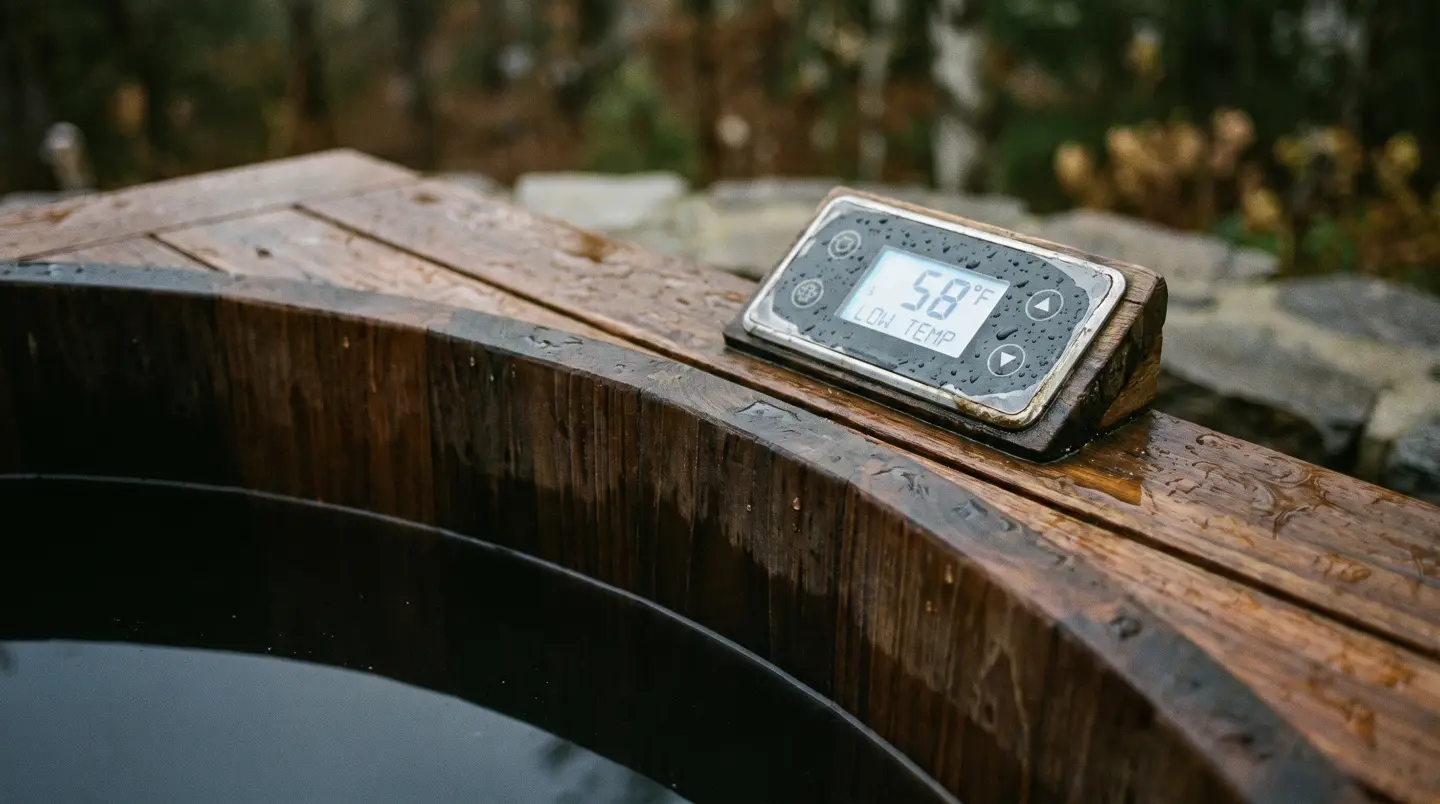
A ½–1 HP ice bath chiller at a Bali villa typically adds IDR 300,000–700,000 a month to the PLN bill, most of it spent holding temperature through the afternoon, and it hums about as much as a small air-conditioner outdoor unit. Where it stands, whether the tub has a lid and which set point you choose decide both numbers more than the brand does. Sizing still matters: ½ HP suits one shaded household tub, 1 HP anything colder, sunnier or busier, and the arithmetic follows below.
How much heat has to come out of the water?
Start with the tub. A one-person plunge holds 300–350 litres once you are in it; a two-person tub 400–500. Water needs 4.19 kJ to cool each litre by 1 °C. Taking 350 litres from 30 °C to 8 °C, a drop of 22 °C, means removing 350 × 4.19 × 22, roughly 32,000 kJ, which is about 9 kWh of cooling. That is the pull-down load, and it only has to happen once per fill, usually overnight. The number is not scary; what surprises owners is the second load.
What does a Bali afternoon do to a cold tub?
A tub at 8 °C standing in 32 °C air with the sun on the deck gains heat continuously through its walls, its lid and its surface, and each bather adds more: a body at 37 °C in the water for three minutes, plus the warm air that comes in when the lid is off. Uninsulated tubs lose the fight by mid-afternoon. In practice three things decide the holding load: whether the tub is insulated and lidded, whether it is in shade, and how many people use it per hour. A shaded, lidded, insulated villa tub used by two people a day needs only a few hundred watts of continuous cooling; an open tub on a Berawa deck in full sun with surfers rotating through needs several times that.
½ HP or 1 HP: which plunge chiller for which tub?
Chiller nameplates in horsepower describe the compressor, not the cooling. In Bali's ambient, where the condenser is already breathing 30 °C air, a ½ HP unit delivers roughly 1–1.5 kW of cooling and a 1 HP unit roughly 2–3 kW. Divide the 9 kWh pull-down by those figures and you get 6–9 hours and 3–5 hours respectively. The holding load then decides whether the machine idles or runs flat out all afternoon, which is also what decides your electricity bill.
| Plunge | Target | Chiller | Pull-down |
|---|---|---|---|
| Villa tub 300–400 l, shaded, lidded, 1–2 users a day | 10–15 °C | ½ HP | 6–9 h |
| Villa tub 300–400 l, sunny deck or 3–5 users | 8–12 °C | 1 HP | 3–5 h |
| Villa tub, target 3–5 °C | 3–5 °C | 1 HP | 4–6 h |
| Studio tub, 16-hour duty, 6–10 users an hour | 5–10 °C | 1 HP per tub, or larger | 3–5 h overnight |
The rule we apply on surveys in Canggu, Uluwatu and Ubud is simple: ½ HP for a single shaded household tub at 8 °C or warmer; 1 HP for anything colder, sunnier or busier; and never one chiller for two tubs in a studio, because the second tub is always the warm one by 16:00.
Where should the tub and the chiller actually stand?
Placement changes the chiller size more often than the tub volume does, and it is the part of the survey we spend the longest on. Five patterns cover most of the island.
- Pererenan and Cemagi pool decks. Wide, open and hot from 10:00. The tub goes on the shaded side of the cabin or under a pergola; the chiller stands on a level pad 2–3 m away with clear air, never boxed into a planter. Deck drainage runs to the villa soakaway, not onto the neighbouring paddy.
- Umalas and Kerobokan garden compounds. Mature planting gives natural shade, which is a gift, but leaf litter is not; a lidded tub and a skimmer sock solve it. Lanes here are 2–3 m wide, so the tub and chiller arrive as a two-person carry.
- Bingin and Uluwatu sunset terraces. Full afternoon sun, wind and salt. This is 1 HP territory even for a single-household tub, with an insulated wall, a hardwood lid and a monthly condenser rinse.
- Ubud jungle terraces. Cooler air makes the chiller's life easier, but canopy fall clogs a skimmer within days, so the tub sits under the roof overhang and nothing wooden touches soil.
- Sanur and Nusa Dua gardens. Easy truck access and gentle sea breeze; a shaded tub with a ½ HP chiller behaves itself, and beachfront lanes still get stainless hardware.
Wherever it lands, the tub wants a hard level base, a fall to a drain for changes, and a hot room within ten steps if you also plan a dry sauna or a roofed outdoor sauna — sizing both at once saves a trench and a circuit.
What else changes the answer in Bali?
- Insulation and a lid: a 30 mm insulated wall and a closed lid can halve the holding load, which is the cheapest cooling you will buy.
- Shade and airflow: the chiller needs 50 cm of clear air around its condenser and a spot out of the sun; a chiller in a hot cupboard loses a third of its capacity.
- Salt air: in Berawa, Seseh, Bingin and on the Sanur beachfront, rinse the condenser fins monthly or the capacity drops season by season.
- Electricity: a ½ HP chiller draws about 0.5 kW and a 1 HP about 1 kW, so both run on a 2,200 VA supply; expect IDR 300,000–700,000 a month at daily use.
- Water quality: well and tanker water on the Bukit need a pre-filter so the cartridge and the chiller's heat exchanger stay clean.
What does the chiller add to the villa power bill?
A ½ HP chiller draws roughly 0.5 kW while its compressor runs and a 1 HP unit roughly 1 kW. Once the tub is at temperature neither runs continuously: the compressor cycles on and off to hold the set point, so the monthly figure depends on how much heat the tub keeps gaining. In practice that lands in the IDR 300,000–700,000 a month range we quote for daily use, with a shaded, lidded household tub at the bottom and a sunny, open, busy tub at the top.
- Keep the lid on. An open tub in 32 °C air is the single biggest reason a bill sits at the top of the range.
- Pick a realistic set point. Holding 10 °C costs far less than holding 5 °C, and most owners settle on 8–12 °C after the first month.
- Give the condenser shade and air. A unit breathing hot air from a closed cupboard runs longer for the same result.
- Change water on a schedule, not daily. Every refill starts again from 28–30 °C; filtration and ozone stretch a household tub to weeks between changes.
How loud is a chiller, and where should it go?
A plunge chiller makes the same kind of sound as an air-conditioner outdoor unit: a compressor hum and a fan. On a detached Pererenan villa that is rarely noticed; in a Berawa or Umalas compound with neighbours two metres away, or under a bedroom window, it can be. We place the unit on a solid plinth with rubber pads, away from bedroom walls and the boundary, with at least 50 cm of free air around it and the pipe run kept short and insulated. Boxing it in to hide the sound is the one fix that backfires: a unit that cannot breathe runs longer and louder.
If the only possible spot is close to where people sleep, a timer can pause the chiller for a few quiet hours. The trade-off is honest: an insulated, lidded tub drifts up a few degrees overnight and needs time to recover, so the pause should end a few hours before the first morning session.
What does an ice bath in Bali cost to build and to run?
Once the size is settled the budget is short and predictable. All figures indicative, in IDR, installed by us on the mainland, with USD at IDR 16,500 per USD for orientation.
| Line | Indicative price | Lead time |
|---|---|---|
| Wooden cold plunge with chiller, filtration and ozone | IDR 45–90 million (approx. USD 2,700–5,500) | 1–2 weeks |
| Chiller only, ½–1 HP, plumbed into an existing tub | IDR 25–55 million (approx. USD 1,500–3,300) | 2–4 days |
| Accessories: hardwood lid, steps, thermometer | IDR 1.5–8 million | with the build |
| Running cost, daily use | IDR 300,000–700,000 per month | ongoing |
| Boat freight to Lembongan, Penida or the Gilis | on quote | +1 week |
Where a plunge lands in that range comes down to tub size, timber, whether the chiller is ½ or 1 HP, and how much drainage has to be cut into an existing deck. A cold plunge in Canggu built beside a new sauna is cheaper than the same tub retrofitted alone six months later, because the trench, the pad and the dedicated circuit are done once. The price list sets the plunge against the cabins, and the cold plunge page covers tub construction in detail.
Five sizing mistakes we are called in to fix
- One chiller, two tubs. A splitter looks economical on paper and delivers two lukewarm tubs by mid-afternoon. One chiller per tub, always, and that is the first thing we check in a studio that has called us in.
- The chiller in a sealed cupboard. A machine that cannot breathe rejects heat into its own inlet air. Fifty centimetres of clear space and a louvred door recover a third of the capacity for the price of a carpenter's afternoon.
- No lid, no insulation. An uninsulated open tub in the sun asks the chiller to fight the whole afternoon and doubles the electricity bill for the same water temperature.
- Filtration treated as optional. Without a cartridge filter and ozone or UV the water needs changing every two or three days, which in Bali's water prices costs more than the treatment stage would have.
- Sizing for the average, not the peak. A tub that serves one household at dawn is a different machine from one that serves five people after a Batu Bolong session; size for the busiest hour, then let the chiller idle the rest of the day. For studio throughput, the recovery studio guide has the numbers.
Frequently asked questions
Can I use bags of ice instead of a chiller?
For a one-off, yes: 20 kg of ice drops a 350 l tub by roughly 4–5 °C and is gone in a couple of hours at 30 °C. For daily use the ice bill overtakes the chiller's running cost within weeks, and the tub never reaches 8 °C.
Should I run the chiller all day or on a timer?
Timer overnight for pull-down, then continuous holding during the hours the tub is used. Most villa controllers are set to start at 22:00 and hold from 05:00; a studio runs its chillers continuously through the 16-hour day.
Does the chiller need a PLN upgrade?
No. Even a 1 HP chiller with its pump draws about 1.1 kW, well within a 2,200 VA supply. It gets its own breaker and an ELCB, which we install with the tub.
How long does a chiller last in Bali's climate?
Longer than owners fear, if it is shaded, has airflow and gets its condenser rinsed monthly near the coast. The units that fail early are the ones boxed under a bench in full sun with salt-crusted fins. We check gas and airflow at the yearly service and hold spares on the island.
Can a plunge and a sauna share one electrical circuit?
No. A Harvia heater gets its own SiHF circuit, breaker and ELCB, and the chiller and pump get theirs. They are different loads with different fault behaviour, and separating them means a tripped plunge never takes the sauna down in the middle of a guest's session.
We size the chiller for you on the free survey, based on where the tub will stand and who will use it. See the ice bath and cold plunge page for tub options, the Canggu and Pererenan zone page for what the coast does to a machine, and the price list for chiller and tub prices in IDR and USD.