Dry sauna
Dry sauna builder in Bali: custom cedar cabins for villas
Finnish-style 70–90 °C cabins in cedar, spruce or thermowood, sized to your room and your PLN meter. Three years of Bali villa builds taught us to fit the foil and vented gap first — it is why our cabins still smell of cedar, not damp, after a wet season.
This is a custom-built cabin holding 70–90 °C at 10–20 % humidity, made for Bali villa owners, retreat hosts and studio founders who want genuine Finnish-style heat rather than something that arrived flat-packed. A 2×2 m four-person cabin runs IDR 60–120 million (approx. USD 3,600–7,300): 1–2 weeks to fabricate in the workshop, then 2–4 weeks on site to finish the install.
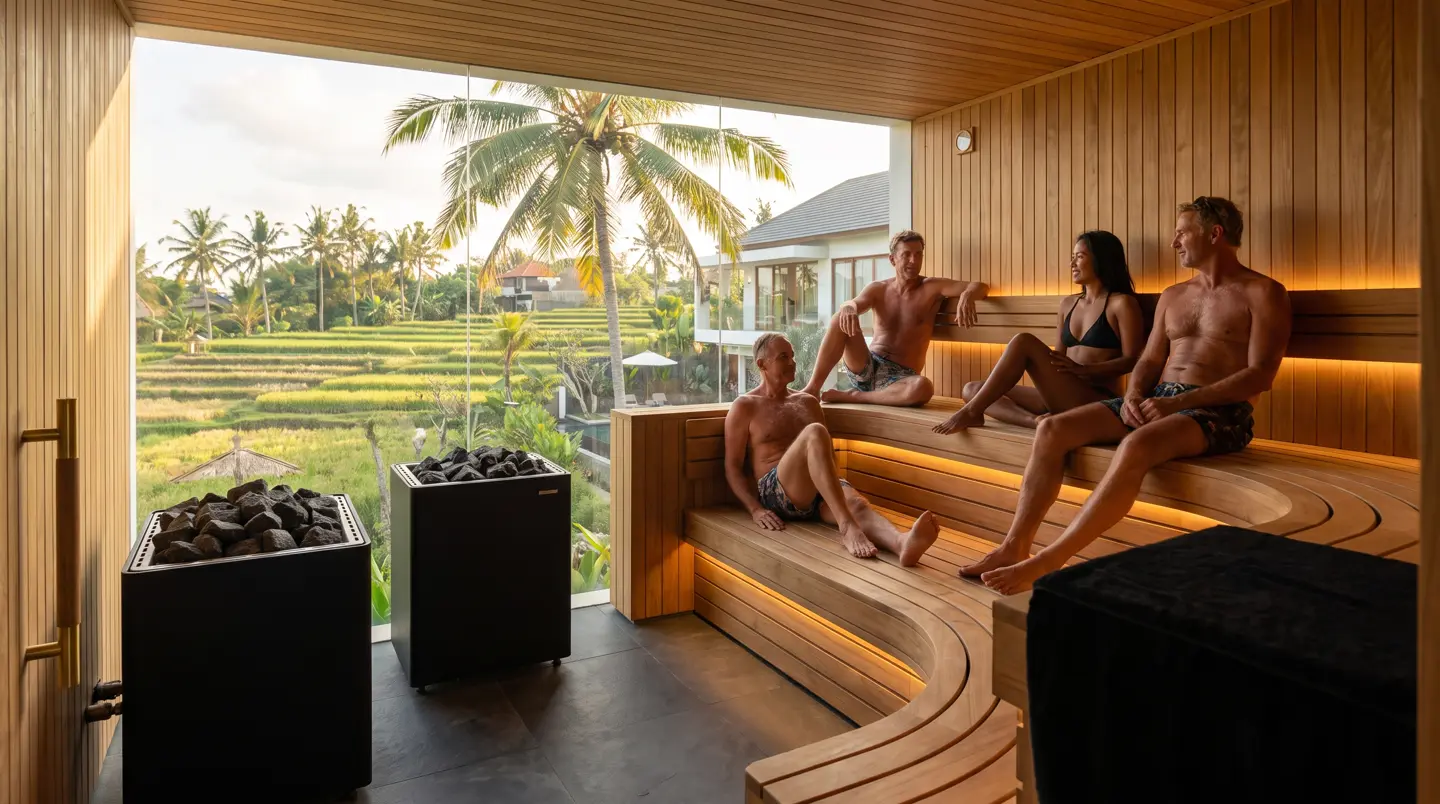
Building a cabin that survives Bali's humidity
A dry sauna in Bali is fighting the climate on every day it is switched off, not just when it is running. At 80–90 % relative humidity, moisture works its way through untreated timber and settles into the insulation, and a cabin built the way it would be in Europe will mould behind the cladding within 2–3 years. That is why every wall here goes together as a sandwich: exterior panel, 50 mm rockwool, an aluminium-foil vapour barrier taped at every joint, a 20 mm ventilation gap, then the interior cladding. The foil keeps steam away from the insulation; the gap lets the cladding dry out from behind it.
Inside, we use western red cedar, Scandinavian spruce or thermowood, with benches in aspen or abachi because both stay cool enough to sit on at 90 °C. Local hardwoods like ulin and bengkirai are genuinely good choices outdoors, on decking and thresholds, but they do not belong inside a hot room. Ventilation always comes as a pair — a supply vent low near the heater, an exhaust set high on the opposite wall — so the cabin breathes while it is running and dries out once it is not. Along the coast, from Berawa through Pererenan and down to Bingin, every screw, hinge and heater guard is stainless, because salt air will corrode zinc-plated hardware inside a single season.
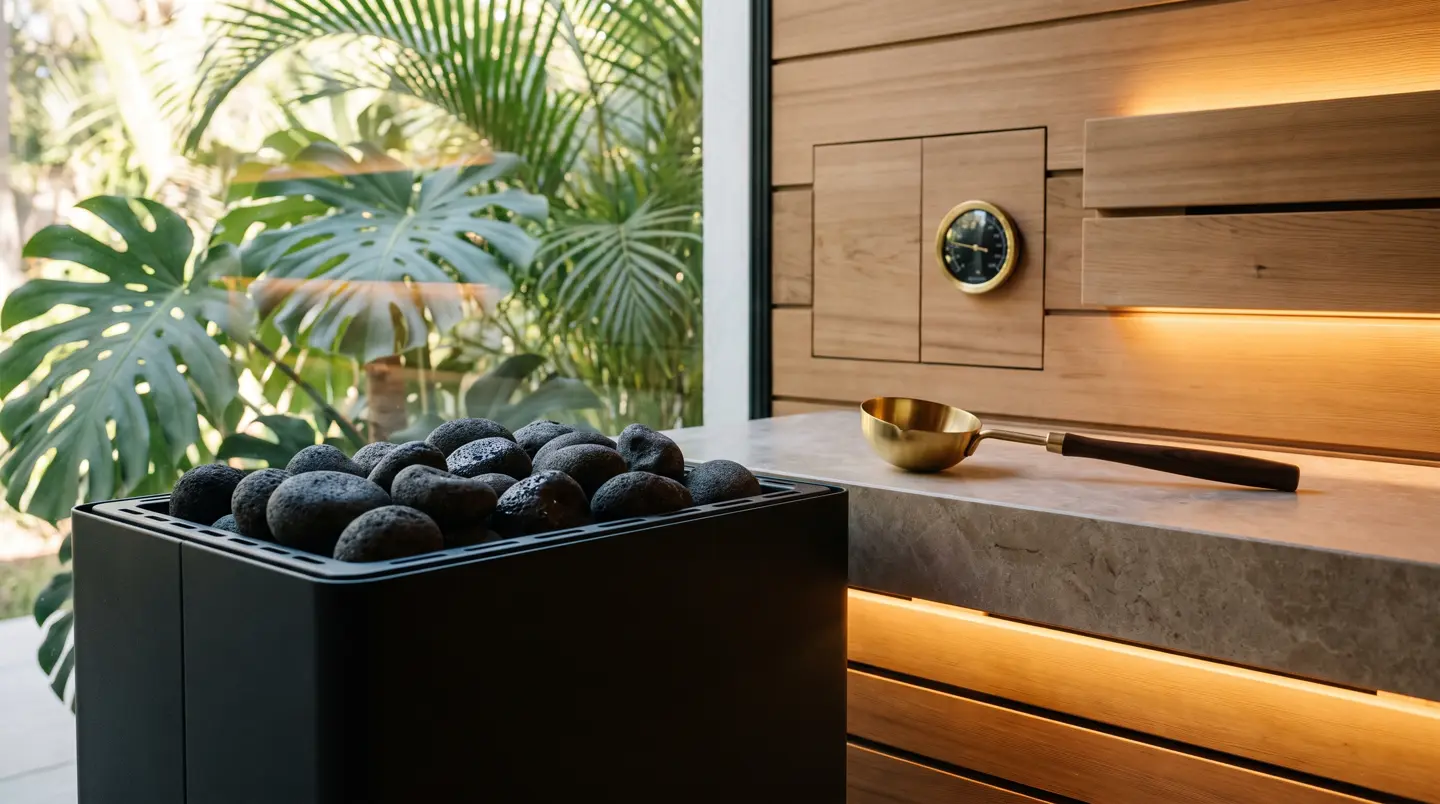
Sizing the cabin and the power it will draw
The request we hear most is a four-person cabin around 2×2 m with a 6 kW heater. Drop to a two-person cabin at 1.5×1.2 m and the heater comes down to 3.6 kW; go up to six people at 2.4×2 m and it climbs to 8 kW; eight people in a 3×2.4 m room needs 9 kW. Past that, 10.5–12 kW heaters for retreat or studio saunas run on three-phase power. Every cabin leaves with an 8 mm tempered-glass door, a heater guard and a bucket-and-ladle set as standard, and handover only happens once we have test-heated it with you standing in the room.
Electricity gets checked before wood choice or size, not after. A 3.6 kW heater runs happily on a 5,500 VA supply; a 6–9 kW heater wants 7,700–11,000 VA, which in older parts of Umalas, Seminyak or Sanur usually means a PLN upgrade up from 2,200–5,500 VA — the owner applies for and pays that upgrade, and we put the exact capacity needed on the quote itself. The heater always gets its own circuit in heat-resistant SiHF cable, a dedicated breaker and an ELCB. When an upgrade genuinely is not possible, an infrared sauna at 1.7–2.4 kW is the honest fallback.
Getting it installed, wherever the villa sits
While your site is being prepared, the cabin itself is taking shape in our workshop near Canggu, then arrives as panels. Indoor builds in Berawa, Umalas and Sanur typically fill a spare room, a pool house or a converted garage, and run 2–4 weeks on site including the electrics. Outdoor cabins on rice-field plots in Pererenan or jungle terraces in Ubud get a raised base, an overhanging roof and a small porch for towels — covered in more detail on the custom and outdoor sauna page. Stair-only access around Bingin and Uluwatu is not a problem, since nothing we deliver is heavier than two people can carry between them.
Heaters come from Harvia, Sawo or Tylö, carry 1–2 years of factory warranty, and spare parts are held on the island rather than ordered from overseas; the cabin structure itself carries our own 2-year warranty separately. A villa sauna used four or five evenings a week typically costs IDR 200,000–500,000 a month to run at standard PLN rates. Nusa Lembongan and the Gili islands are reached by cargo boat, freight quoted on request. For the full breakdown of what moves the price up or down, see the sauna price list for Bali.
What it costs, configuration by configuration
| Configuration | Indicative cost |
|---|---|
| Economy build, mixed materials | from IDR 40 million |
| 2-person cabin, 1.5×1.2 m, 3.6 kW, pine | IDR 55–70 million |
| 4-person custom cabin, 2×2 m, cedar | IDR 60–120 million |
| 6-person cabin, 2.4×2 m, 8 kW, thermowood | IDR 110–150 million |
| Heater swap only, 6–9 kW, fully installed | IDR 15–35 million |
Ballpark figures in IDR that leave out any PLN upgrade or civil works — IDR 60–120 million comes to roughly USD 3,600–7,300 at IDR 16,500 per USD.
What villa and studio owners ask us
How long before the cabin actually reaches temperature?
A properly insulated 2×2 m cabin with a 6 kW heater gets to 80 °C in roughly 30–45 minutes. Starting from a Bali ambient of 28–32 °C rather than a European 15 °C actually shaves a little off that time, though a cabin missing its foil barrier loses that head start to damp insulation within about a year.
Can the cabin be finished to match our villa's existing wood or stone?
Yes, and it is worth deciding before the timber is ordered. Cedar and thermowood both take a similar tone to teak and ironwood joinery, so a cabin can sit inside a villa without looking like an add-on; a stone threshold or an accent wall in the same material as the bathroom pulls it together further. We ask for photos of the room at quote stage specifically so the cladding and any stone or tile detailing can be matched rather than guessed at.
Which timber actually holds up best in Bali's climate?
Western red cedar and thermowood have the strongest track record locally — both shrug off moisture and neither weeps resin in the heat. Spruce is a perfectly sound budget cladding as long as it sits behind a correctly built vapour barrier. Benches are always aspen or abachi regardless of budget, since both stay cool underfoot and will not splinter.
Will you service or fix a sauna another company built?
We do. Swapping in a 6–9 kW Harvia, Sawo or Tylö heater runs IDR 15–35 million installed, and a fuller renovation — stripping mouldy cladding and adding a proper vapour barrier — runs IDR 15–50 million depending on the size of the cabin.
Areas we cover
Often paired with
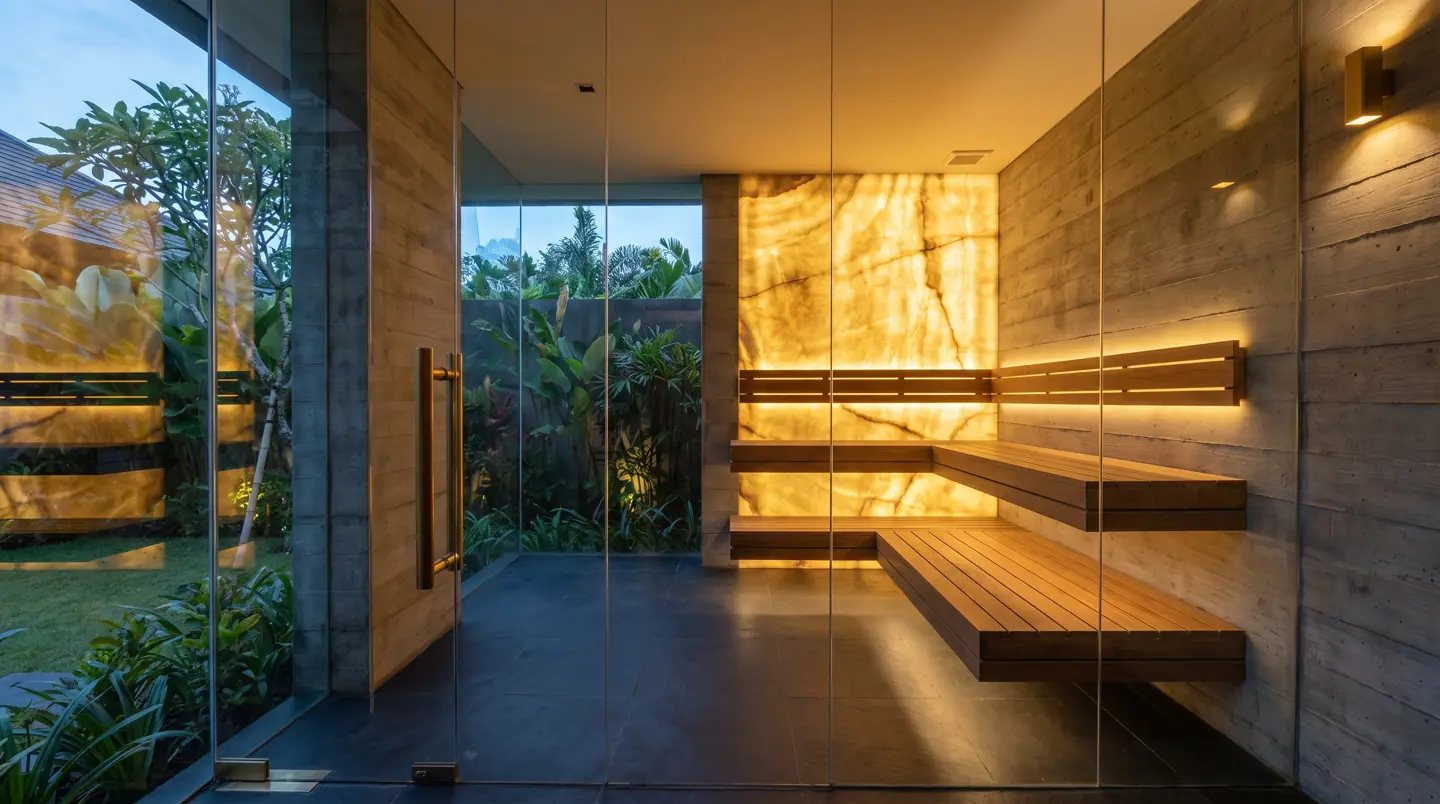
Luxury sauna
Glass-fronted or roofed outdoor cabins finished in stone, thermowood and hidden LED, built for villas where the sauna has to look as good in photos as it feels to sit in.
IDR 80–150 million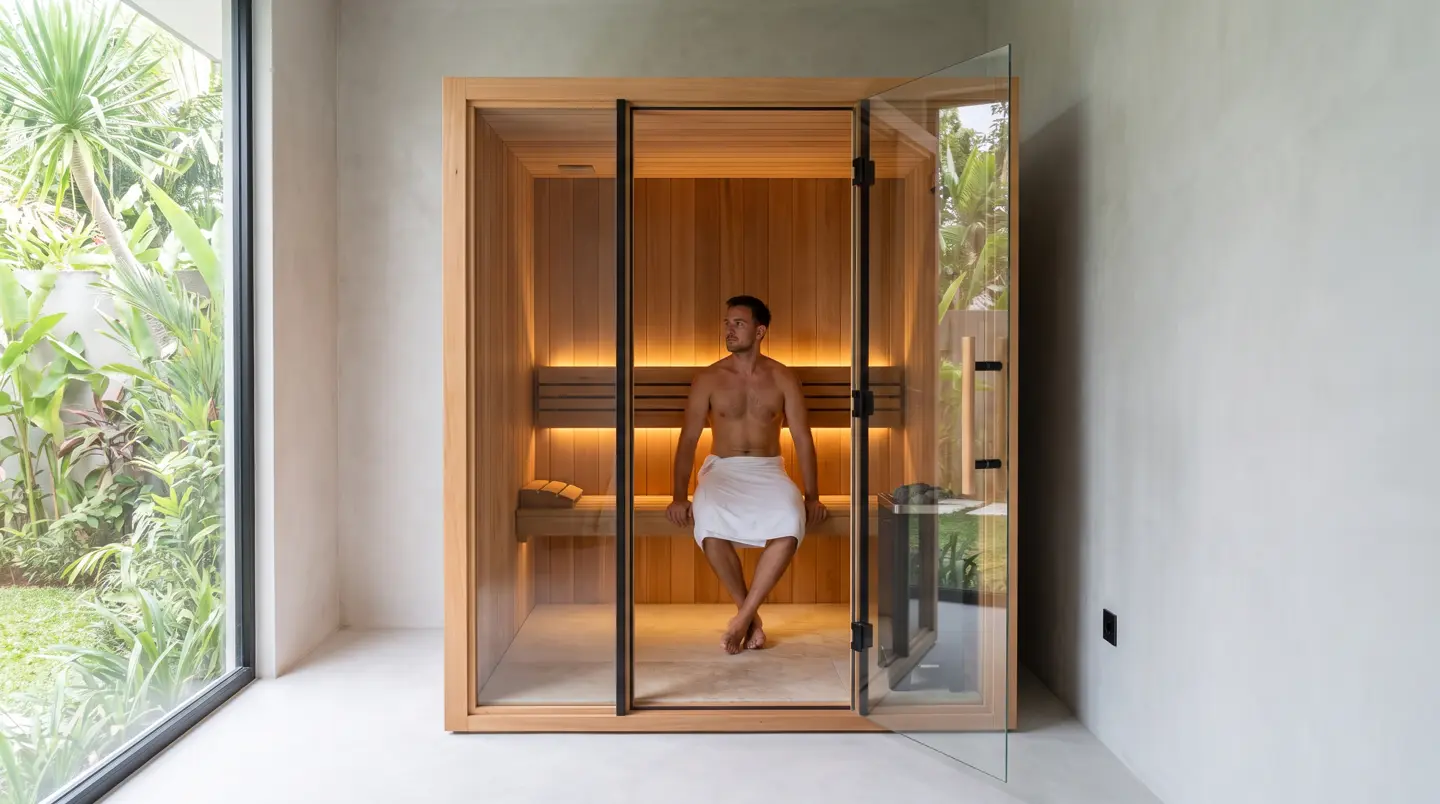
Prefab cabin
A 1.5×1.2 m cabin built ahead of time and shipped complete, so a spare room, terrace or guesthouse can be heating within days, not weeks.
IDR 15–35 million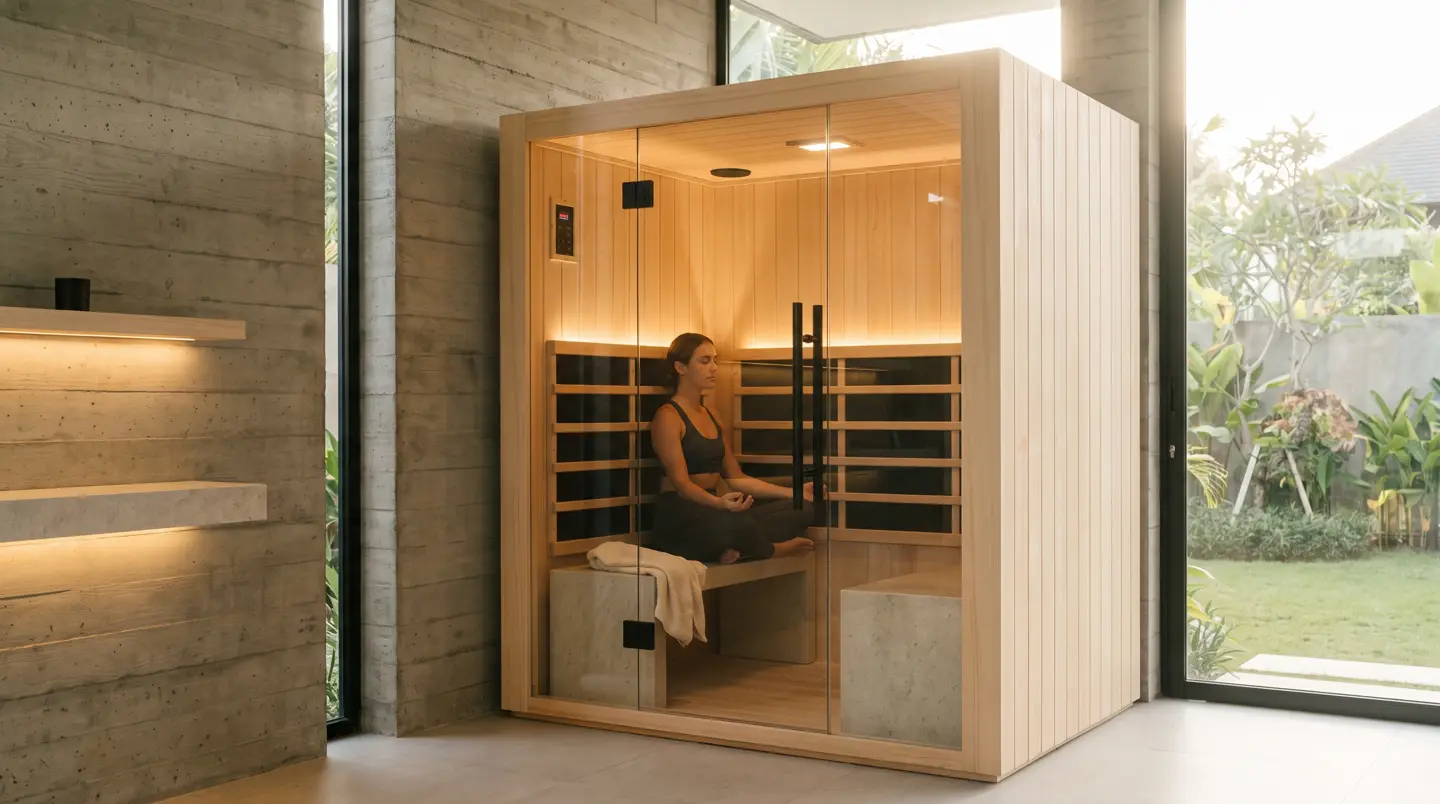
Infrared sauna
1.7–2.4 kW carbon-panel cabins for one or two people, the option when a villa or apartment meter simply will not stretch to a heater upgrade.
IDR 30–70 millionStart here
Tell us what you're picturing, we'll price it out
A couple of minutes here saves a week of back-and-forth later — a project manager replies on WhatsApp within working hours, usually the same day.
Ready to see it in your own space?
Photograph the spot you have in mind, plus your meter box, and send both over WhatsApp. Expect a reply the same working day and a survey slot inside the week.