Steam room
Steam room builder in Bali: 45 °C, 100 % humidity, no leaks
Tiled 40–45 °C steam rooms with a proper fall, drain and sized generator, IDR 50–100M for villas. After more than 100 Bali projects the order never changes: tanking first, tile second.
This is a waterproofed, mosaic-tiled room held at 40–45 °C and close to 100 % humidity by a 6–9 kW steam generator, built for Bali villa owners who prefer wet heat over dry, and for spas and hotels around Seminyak, Ubud and Nusa Dua. A 2×2 m room runs IDR 50–100 million (approx. USD 3,000–6,100) and takes 3–5 weeks to build.
Why waterproofing decides everything else about the build
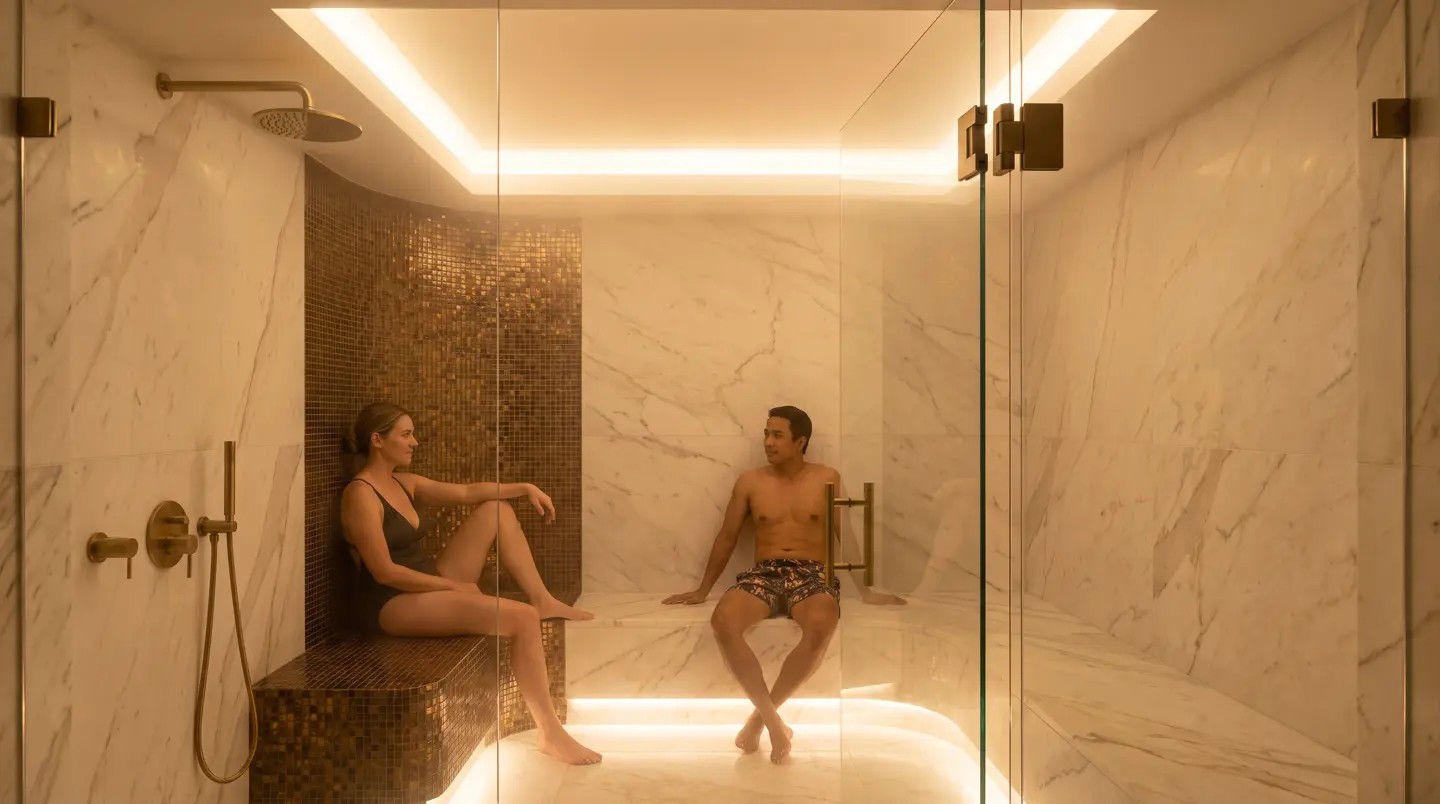
A steam room in Bali is a wet room before it is a wellness room. Running at 40–45 °C and close to 100 % humidity, every surface streams with condensate for as long as the generator is on, and in a climate that already sits at 85 % ambient, a single leak will show up as mould in the room next door within a year. So the build sequence never changes: a cement-board or block shell, a continuous liquid membrane across floor, walls and ceiling, a floor falling to a drain at 1–2 %, a ceiling sloped at 10–15 % so condensation runs to the wall rather than onto shoulders, and only then the mosaic goes on. The door is 8 mm tempered glass in a stainless frame with a threshold that keeps water inside the room. A mechanical exhaust dries everything out after each session — skip it and the grout turns black within months.
The steam itself comes from a 6–9 kW generator tucked in a service cupboard next door, feeding a low corner nozzle with an aroma dosing point built in. Benches are tiled and warmed by the room itself; a curved bench adds cost over a straight one, but it is what most villa owners in Berawa and Umalas end up asking for.
What the generator needs, electrically and in water
Electrically, the generator does all the work. A 6 kW unit for a 2×2 m room wants a 7,700 VA supply; step up to 9 kW for a larger or glass-walled room and that becomes 11,000 VA; anything commercial runs three-phase. Since older villas around Seminyak, Kerobokan and Sanur often sit on just 2,200–5,500 VA, a PLN upgrade — applied for and paid by the owner — is usually part of the plan from the start. The generator gets its own dedicated circuit in SiHF cable, a breaker and an ELCB, plus a drain for its blow-down cycle. If an upgrade genuinely is not on the table, wet heat is not an option and an infrared cabin becomes the fallback.
Water quality matters just as much as the electrical side. Well water on the Bukit around Uluwatu and Ungasan, along with much of the town supply, runs hard, and that scale builds up in the generator tank and shortens the heating element's life. A softener or scale filter on the feed is standard on every job we do, alongside a flush scheduled every one to three months. A villa steam room used four or five times a week typically costs IDR 300,000–600,000 a month to run.
From a villa ensuite to a hotel wellness floor
In Canggu, Berawa and Seminyak, villa steam rooms usually take over or extend an existing bathroom and share its drain, running 3–5 weeks including tiling. Spa and hotel jobs in Nusa Dua, Jimbaran and Ubud are a different scale entirely — larger rooms, 12–16 hours of daily use, a 9 kW or three-phase generator with a duty-rated exhaust, priced from IDR 150 million and taking 4–8 weeks. We also take on renovations where an old membrane has failed, which turns up often in villas built during the 2000s, for IDR 15–50 million depending on how much of the shell needs to come out.
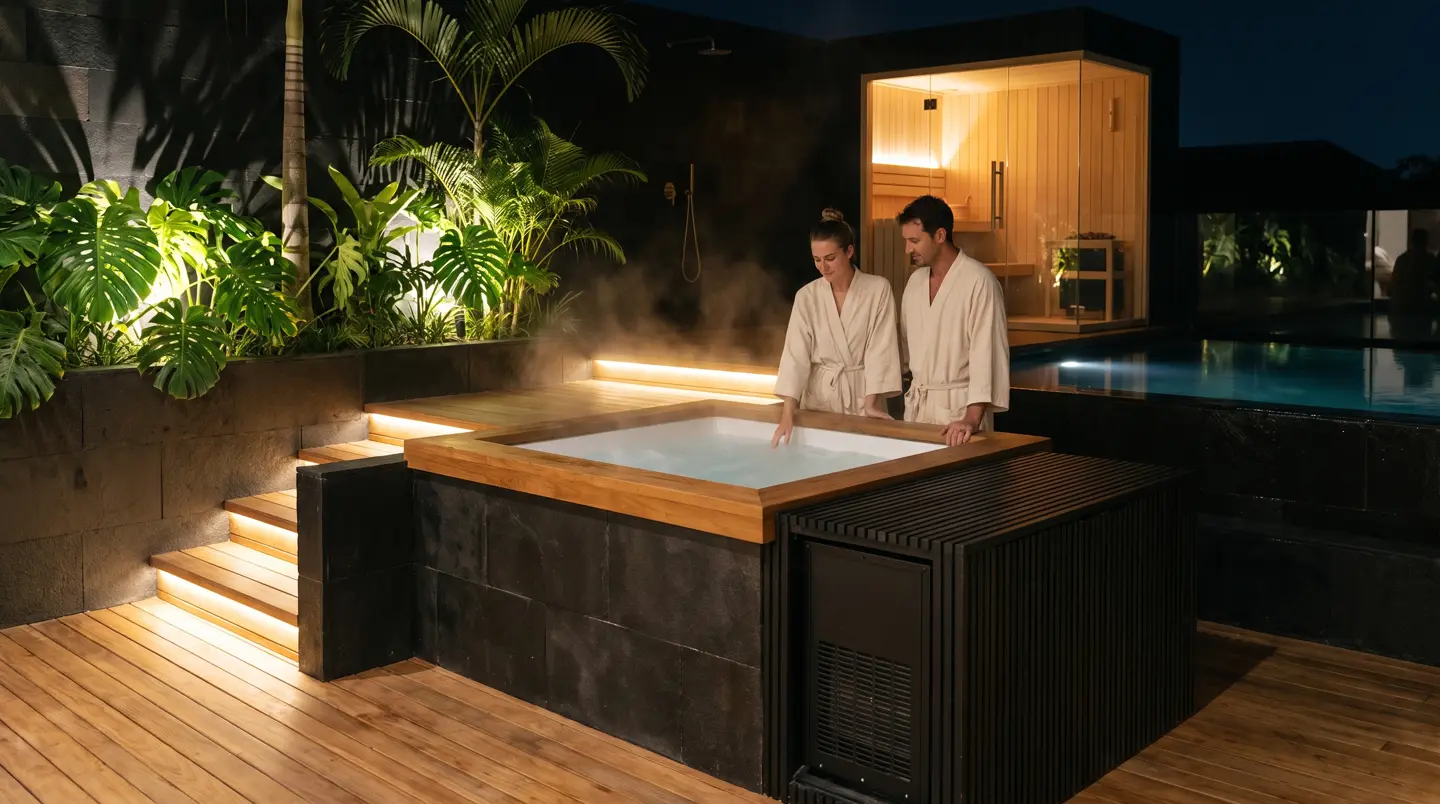
It is common for owners to pair the steam room with a cold plunge in the same wet area, sharing both the drain and the service cupboard. The price list sets steam rooms alongside dry saunas so the cost and running expense of each are easy to weigh up.
What it costs, scope by scope
| Scope | Indicative cost |
|---|---|
| Villa steam room, 2×2 m, fully turnkey | IDR 50–100 million |
| Renovation of an existing, failed steam room | IDR 15–50 million |
| Commercial build for a spa or hotel | from IDR 150 million |
| Monthly running cost, typical villa use | IDR 300,000–600,000 |
Ballpark figures in IDR — IDR 50–100 million works out to roughly USD 3,000–6,100 at IDR 16,500 per USD — and do not yet include a PLN upgrade if you need one.
What comes up when we quote a steam room
Can it go on an upper floor and still match our bathroom tiles?
Yes on both counts. Structurally it needs a membrane that runs up the walls at least 20 cm, a drain tied into the floor below, and a leak test before any tiling starts — routine work for us in Seminyak townhouses. Because the membrane goes down before the finish, matching the mosaic or tile to the rest of the bathroom is a design choice, not a structural one, and we plan it in at quote stage.
Can this be built while the villa or spa keeps operating?
In most cases, yes. The generator and plumbing work can be scheduled around a booking gap or a quieter period rather than shutting the property down, since the noisiest and messiest stage — the shell and waterproofing — is contained to the one room. For a spa or hotel, we typically sequence the work room by room so the rest of the wellness area stays open to guests throughout.
Should we build a steam room or a dry sauna instead?
If the target audience is guests, a dry sauna is both the more commonly searched amenity and the cheaper one to run day to day. If the owner personally prefers wet heat, or the space in question is already a bathroom, the steam room makes more sense. Either way, a full-size room needs 7,700–11,000 VA.
How much upkeep does the generator actually need?
A flush every one to three months, depending on how hard the water is, plus a full tank descale once a year. The softener cartridge gets swapped every six months. For villas managed remotely, we can put together a maintenance visit schedule so none of this depends on someone on-site remembering.
Where we build these
Complements
Dry sauna
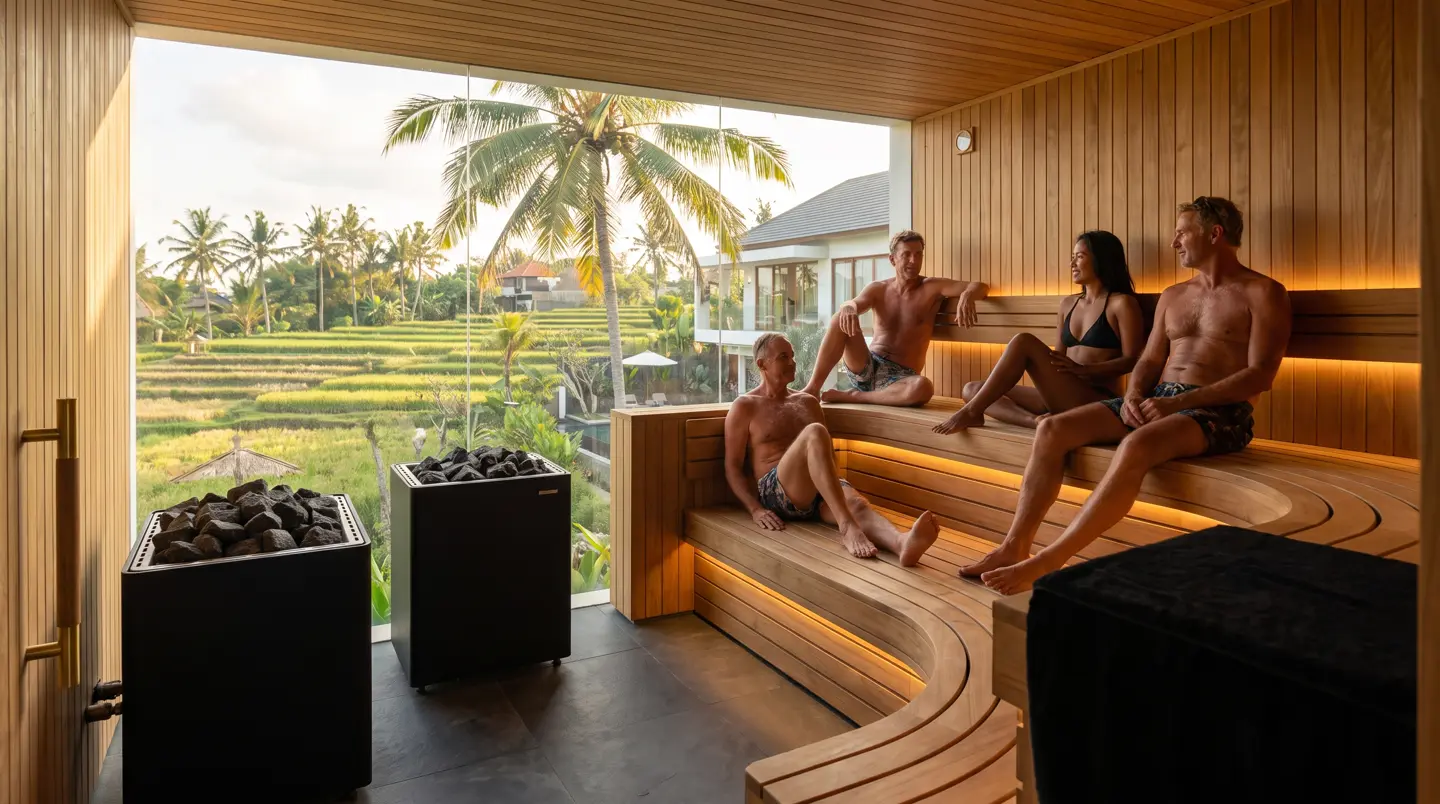
70–90 °C cedar, spruce or thermowood cabins, sized to fit the room you have and the meter you are allowed to run.
IDR 60–120 million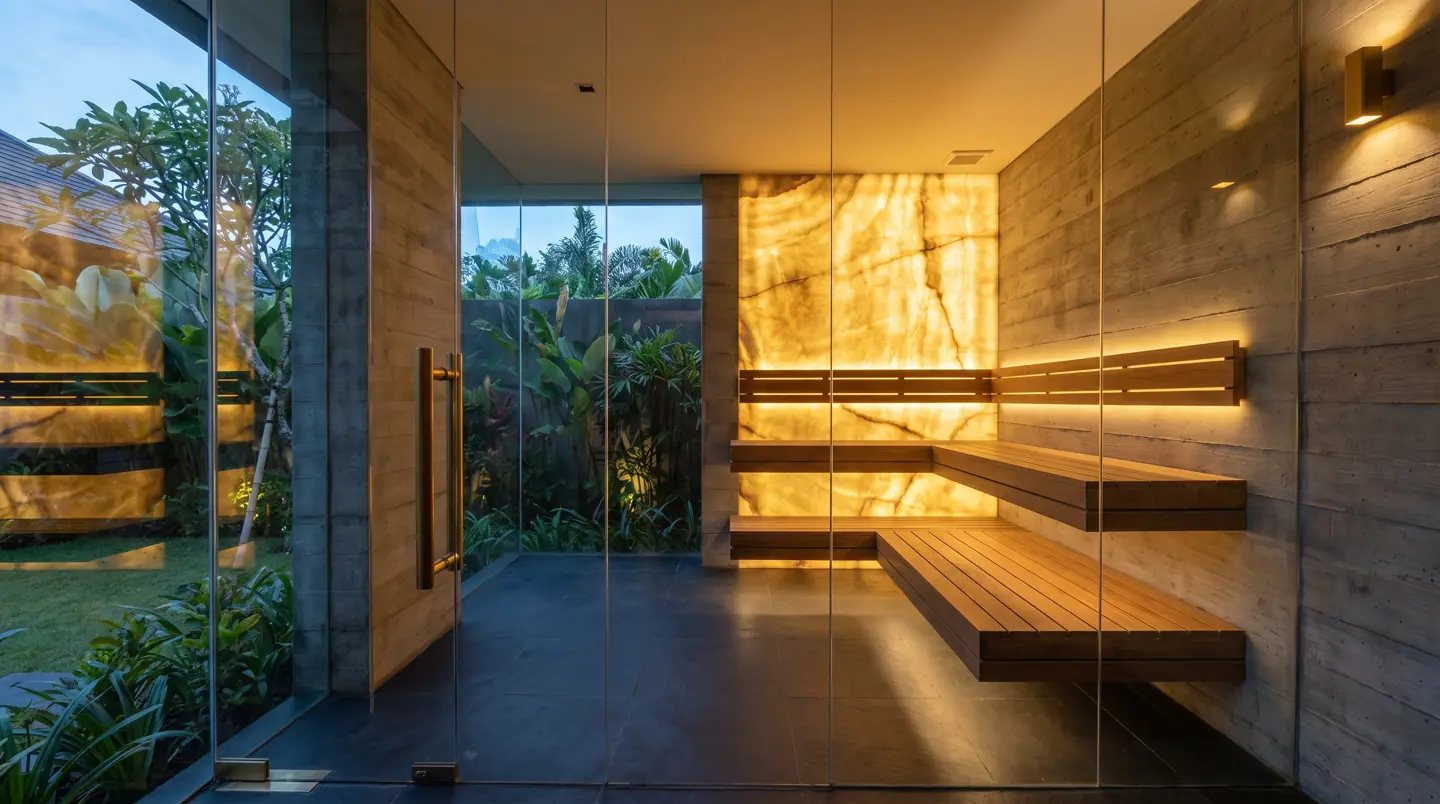
Luxury sauna
Glass-fronted or roofed outdoor cabins finished in stone, thermowood and hidden LED, built for villas where the sauna has to look as good in photos as it feels to sit in.
IDR 80–150 million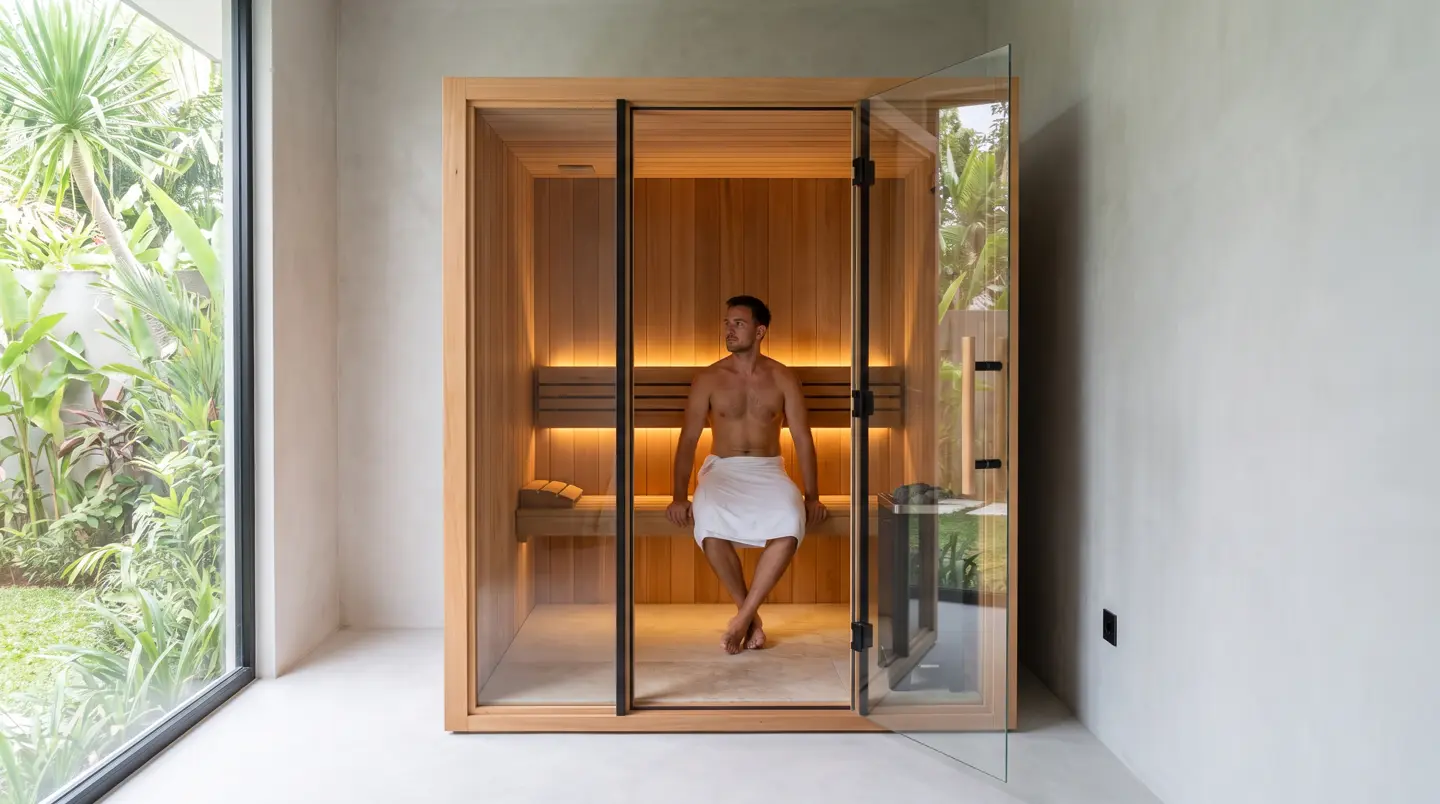
Prefab cabin
A 1.5×1.2 m cabin built ahead of time and shipped complete, so a spare room, terrace or guesthouse can be heating within days, not weeks.
IDR 15–35 millionStart here
Tell us what you're picturing, we'll price it out
A couple of minutes here saves a week of back-and-forth later — a project manager replies on WhatsApp within working hours, usually the same day.
Ready to see it in your own space?
Photograph the spot you have in mind, plus your meter box, and send both over WhatsApp. Expect a reply the same working day and a survey slot inside the week.