Guides
Salt air, humidity and mould: building a sauna that lasts in Bali
Most saunas that fail in Bali fail the same way: damp insulation behind the cladding, black mould at the bench joints and rust on the heater guard, usually within 2–3 years. The causes are 80–90 % humidity, salt air within 2 km of the coast and a wall built for a dry climate. The fix is a specific wall build-up, stainless hardware and a ten-minute weekly habit.
Why does a sauna go mouldy in Bali when it would not in Europe?
A sauna wall in Finland dries out between sessions because the air outside the cabin is dry. In Canggu, Ubud or Sanur the air outside the cabin is at 80–90 % humidity all year and 95 % on a wet-season morning. Warm, moist air from the hot room pushes into the wall when the sauna runs, cools inside the insulation, and condenses there; with no way out, the rockwool stays wet, the back of the cladding stays wet, and mould follows. Ubud's river valleys are the worst case because nights are cooler and mist is normal; Pererenan and Bingin add salt to the same moisture. The cabin still works, for a while, and then it starts to smell.
What does a wall that survives look like?
From the outside in: an exterior panel; 50 mm of rockwool; an aluminium-foil vapour barrier, overlapped and taped at every joint and turned around windows and cable entries; a 20 mm ventilation gap made with battens, open at the bottom and the top so air moves behind the cladding; and finally the interior cladding in western red cedar, thermowood or spruce. The foil keeps steam out of the insulation and the gap lets any moisture that does get in dry off the back of the boards. Skip either and the cabin has a 2–3 year life in Bali; include both and it has a ten-year one. This is the build-up on every cabin from our Canggu workshop, and the reason a quote for a correct cabin is never the cheapest on the table.
What does salt air do, and where does it reach?
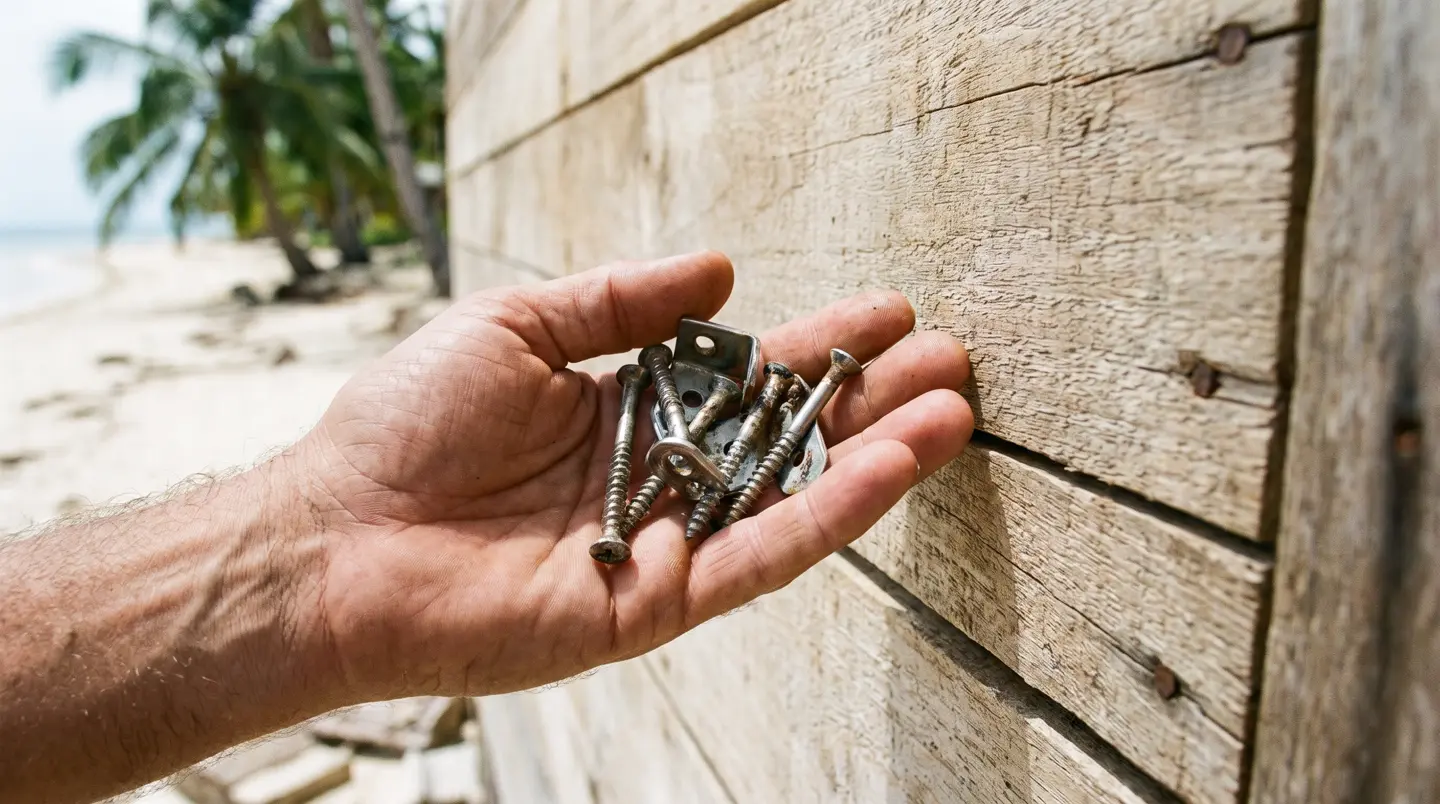
Salt aerosol carries 1–2 km inland on the south-west wind through the dry season, so it reaches all of Berawa, Batu Bolong, Pererenan, Seseh and Cemagi, the cliff villas from Bingin to Uluwatu, and the Sanur beachfront. Zinc-plated screws show rust streaks on cedar within a season; mild-steel heater guards flake within two; hinges seize; chiller condensers lose capacity. The answer is stainless steel throughout, a sealed control panel on infrared cabins, and a monthly rinse of the chiller's condenser fins. Umalas, Kerobokan and Ubud are far enough inland that the salt load is light, but the humidity rules still apply in full.
What does the same air do to a steam room, an infrared cabin and a plunge?
A dry sauna is only the most visible casualty. Each of the other rooms fails in its own way, and each has a specific defence.
- Steam room. The room is at 100 % humidity by design, so the only thing standing between it and the bedroom next door is the membrane. A continuous liquid membrane over floor, walls and ceiling, a floor falling 1–2 % to the drain, a ceiling sloped 10–15 % and a mechanical exhaust are the whole game; grout goes black in months without the exhaust. Failed membranes in villas built in the 2000s are one of our most common renovation jobs, and the steam room page explains the build order.
- Infrared sauna. The enemy is condensation on electronics, not mould in a wall. Carbon panels and controls belong in an air-conditioned or well-ventilated room, never on an open terrace, and near the coast the control panel is sealed. A weekly ten-minute run dries the hemlock or cedar from inside.
- Cold plunge. On an ice bath the moisture is the point, so the defences move to the hardware: a food-grade liner so timber never sits in standing water, stainless bands, a hardwood lid, and a condenser rinsed monthly on the coast. Ozone or UV keeps the water clear for weeks; without it a warm-climate tub goes cloudy in days. Details are on the cold plunge page.
- Outdoor cabin. Rain and UV together. A roof with a 40–60 cm overhang, a raised base, ulin or bengkirai decking and drip edges above the door do more for lifespan than any coating.
Eight checks before you sign a sauna quote in Bali
- Is there an aluminium-foil vapour barrier, and is it taped at the joints?
- Is there a 20 mm vented gap behind the cladding, open top and bottom?
- What is the insulation, and is it 50 mm rockwool rather than foam that traps water?
- Are screws, hinges, handles and the heater guard stainless steel?
- Are there two vents, a supply low by the heater and an exhaust high on the far wall?
- For an outdoor cabin: a roof with a 40–60 cm overhang, a raised base, hardwood decking in ulin or bengkirai?
- Which wood goes inside? Cedar, thermowood or spruce, with aspen or abachi benches; local hardwoods stay outside.
- Is there a handover sheet with the weekly dry-out heating and the monthly checks written down?
The last item matters as much as the first. A cabin used every evening dries itself. A cabin in a rental villa that sits closed for three weeks in February does not, so the manager runs the heater for ten minutes once a week with the door open afterwards. We put that on a laminated card by the door, and it is the difference between a sauna that smells of cedar in year five and one that smells of the wet season.
What does it cost to rescue a cabin that has already gone?
Plenty of the cabins we are asked to look at were bought as kits, or built by a general contractor who had never made a hot room. The good news is that the frame is usually sound; the wet insulation and the cladding are what have to come out.
| Job | What happens | Indicative price | Time |
|---|---|---|---|
| Renovation of a mouldy cabin | Strip cladding, remove wet insulation, fit foil and battens, re-clad, new benches | IDR 15–50 million | 1–3 weeks |
| Harvia heater replacement, 6–9 kW | New unit, guard, SiHF circuit, breaker and ELCB, test heating | IDR 15–35 million | 1–2 days |
| Steam room membrane and tiling rebuild | Shell out, new membrane, falls corrected, re-tiled, exhaust added | IDR 15–50 million | 2–4 weeks |
| Retrofit a chiller to an existing tub | ½–1 HP chiller, pump, cartridge filter, ozone or UV, dedicated circuit | IDR 25–55 million | 2–4 days |
| New cabin when the frame has rotted | Full replacement, custom 2×2 m for four | IDR 60–120 million | 2–4 weeks |
All figures indicative, in IDR, and confirmed only after we open a panel and look at the insulation; a cabin that smells faintly is a renovation, a cabin whose frame is soft at the floor line is a replacement. The price list carries the same rows alongside new builds, so the two can be compared honestly before you decide which way to spend.
A care calendar that takes ten minutes a week
Nothing in this list is difficult; the trick is that somebody owns it. On managed villas we address the card to the housekeeping supervisor, not to the owner in another country.
| How often | What | Why |
|---|---|---|
| Weekly | Ten-minute dry-out heating, door left open afterwards; wipe benches | Drives moisture out of the cladding in weeks with no guests |
| Monthly | Rinse chiller condenser fins; check vent grilles are clear | Salt and dust cost cooling capacity and airflow |
| Quarterly | Restack heater stones, discard cracked ones; test the ELCB; check hinges and glass | Cracked stones choke airflow; a stuck ELCB is a silent risk |
| Twice a year | Inspect the outdoor cabin's base, deck and roof edges after the wet season | Termites and standing water start at ground level |
| Yearly | Service visit: elements, controls, chiller gas, tub liner, membrane joints | Catches wear before it becomes a renovation |
Zone matters here too. In Ubud the weekly dry-out heating is the single most valuable habit, because the valley air never lets a cabin dry on its own. On the Berawa and Bingin coast the monthly condenser rinse comes first. Inland in Umalas and Kerobokan you can be slightly more relaxed about salt and no more relaxed at all about humidity.
Frequently asked questions
Can a mouldy sauna be saved?
Usually. We strip the cladding, remove the wet insulation, fit foil and battens, and re-clad; IDR 15–50 million depending on cabin size. If the structural frame has rotted, it is cheaper to replace the cabin.
Is thermowood better than cedar in Bali?
They are close. Thermowood has been heat-treated so it absorbs less moisture and moves less; cedar has natural oils that resist rot and smells better. Both outlast spruce here, and both need the same wall behind them.
Do termites attack a sauna in Ubud?
They can, from the ground up. Nothing wooden should touch the soil: a concrete or hardwood base, a gap under the cabin, and cedar or thermowood, which termites dislike, keep the risk low. We inspect the base at the yearly service.
How can I tell whether an existing cabin has a vapour barrier?
Take off a bench or a vent grille and look at the wall edge with a torch; foil is unmistakable, and so is bare rockwool. A musty smell when the cabin is cold, dark staining at the bench fixings and cladding that feels cool and damp behind the boards all point the same way.
Should the sauna be shut down during the wet season?
No, the opposite. A cabin that is used stays dry. If the villa is empty through January and February, the weekly ten-minute heating is what keeps it healthy; switching everything off for two months is the fastest way to open it in March to a smell you will not get out.
If you are comparing quotes, send them to us on WhatsApp and we will tell you honestly what is in the wall. Our own build-up is on the dry sauna page, outdoor cabins with roof and deck are on the custom and outdoor sauna page, and renovation figures sit on the price list.